GOC Insights · Engineering & Industrial
Motor rewind to 13.8 kV and 10 MW: repair before replace
Large electric motors are long-lead, high-cost equipment. A tested rewind can return them to service in a fraction of the time a replacement takes to arrive.
When a large motor fails, the first question is not which replacement to order. It is whether the machine can be rewound, balanced and proven at its rated voltage.
Why rewind
High-voltage motors driving pumps, compressors and fans are often built to order. Replacement can take months, and the plant waits. Most failures, however, are in the windings or bearings, not the frame or core, and both can be restored.
What a proper rewind includes
- Inspection and testing to find the cause of failure, not just the damage.
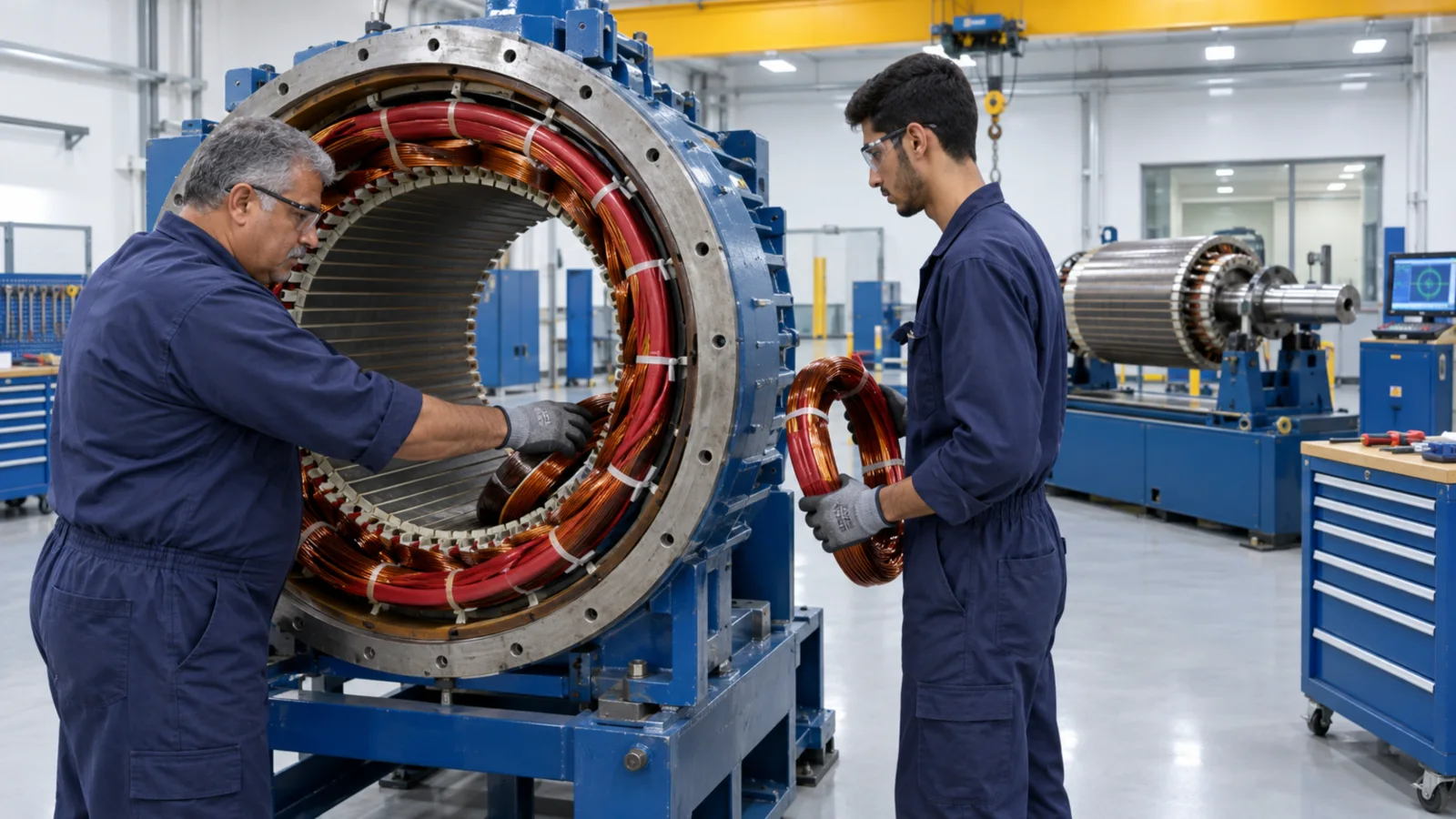
- Rewinding of HV and LV machines, up to 13.8 kV and 10 MW.
- Dynamic balancing of rotors up to 12 t, to keep vibration within limits.
- Test run at rated voltage, up to 6,600 V, before the motor leaves the workshop.
Every motor is test run at its rated voltage before it leaves the workshop.
GOC Insights
Proof before dispatch
The test run is what separates a repair from a promise. Running every motor at its rated voltage confirms the windings, insulation and balance under real conditions, so the plant receives a machine that has already worked.
What GOC delivers
HV and LV rotating equipment repair: rewind up to 13.8 kV and 10 MW, dynamic balancing for rotors up to 12 t, and a test run at rated voltage up to 6,600 V, from our own workshop and test bay.
Explore Engineering & Industrial