
GOC Insights · Whitepaper
Used-oil re-refining: a circular supply for Kuwait’s industry
Used oil is one of the few industrial wastes that can return to service at almost the same quality. The case rests on energy, cost and control of supply.
Kuwait’s refineries, power stations, oilfields and industrial plants consume large volumes of lubricants, transformer oils and turbine oils. Most of it eventually leaves the site as waste. Re-refining offers a different route: the same oil, returned to specification, for a fraction of the energy.
Executive summary
- Base oil does not wear out; it becomes contaminated. Removing the contamination returns it to service.
- Re-refining used oil takes about one-third of the energy needed to refine base oil from crude.
- Transformer and turbine oils can often be treated or reclaimed on site, extending their life without a full change.
- Service, tolling and offtake contracts let operators choose how much risk and ownership they take on.
- Operators who measure volumes, quality and cost per litre can make the case with their own numbers.
The hidden cost of used oil
For most operators, used oil appears twice in the accounts: once as a disposal cost, and again as the purchase of new oil to replace it. Neither line is large enough on its own to attract attention, so the combined cost is rarely examined.
There is also a control issue. Oil that leaves the site as waste must be handled and tracked, and oil bought as replacement depends on supply chains outside the operator’s control.
The energy case
The energy required to manufacture re-refined oil from used oil is only one-third of the energy required to refine crude oil. For an economy where energy is both the main export and a major domestic cost, every barrel of base oil recovered instead of refined from crude is energy saved at source.
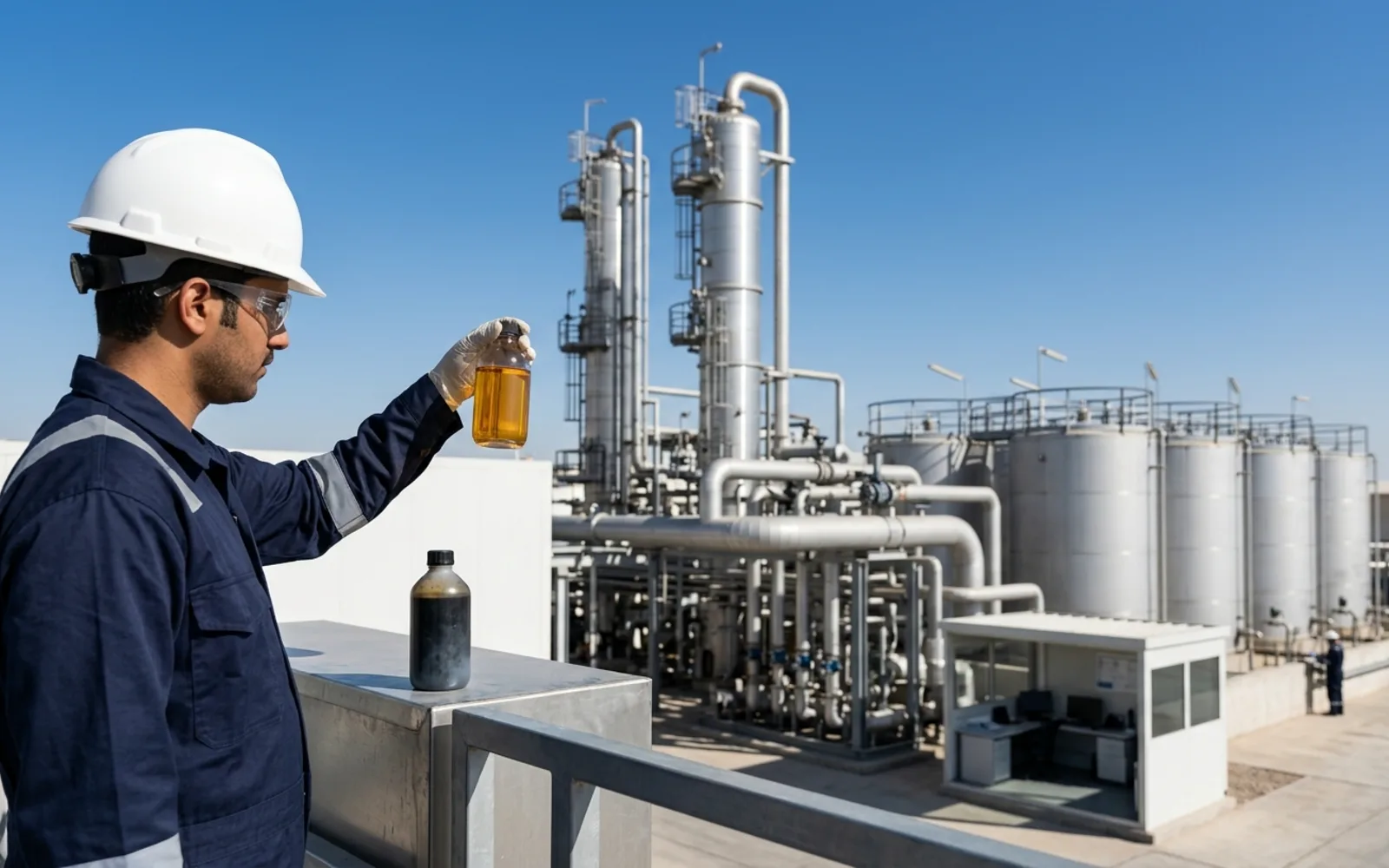
Base oil does not wear out. It becomes contaminated, and contamination can be removed.
GOC Insights
From used oil to base oil
Re-refining removes what service has added. Each stage is matched to the contamination found in the incoming oil:
- Collection and testing to identify the oil type and contamination, and to keep incompatible streams apart.
- Pre-treatment to remove free water and solids.
- Distillation in purpose-built columns to separate base oil from heavier residues.
- Desulfurization to bring sulfur content back within specification.
- Final testing against the required standard before the oil is returned or supplied.
On-site reclamation: transformer and turbine oils
Not every oil needs to leave the site. Transformer oil treatment restores insulating properties and removes moisture; turbine oil reclamation removes oxidation products. Done in place, both extend the service life of the oil and reduce how often a full change is needed, with less material to transport and dispose of.
Contract models
Operators can take different levels of ownership, depending on volumes and risk appetite:
- Service contracts: treatment or reclamation carried out for the operator, on or off site.
- Tolling: the operator’s used oil is re-refined and returned to the operator.
- Offtake: used oil is collected and re-refined oil is supplied under an agreed arrangement.
The right model is agreed per project, after the volumes and quality of the oil have been tested.
What operators should measure
The case for re-refining is strongest when it is made with the operator’s own data. Four measures are enough to start:
- Annual volumes of used oil by type: lubricants, transformer oils and turbine oils.
- Current disposal cost and replacement cost per litre.
- Oil quality on arrival, from a representative set of samples.
- How often transformer and turbine oils are fully changed today.
What GOC delivers
Used-oil re-refining, desulfurization, hydrocarbon and condensate plant, distillation columns, transformer oil treatment and turbine oil reclamation, with water treatment chemistry for industrial plants. Contracts are structured as service, tolling or offtake arrangements, agreed per project.
Explore the Environment capability